Fish Identification: Ozarks Lake Fish & Tailwater Trout
How to tell apart the fish you're most likely to catch, split by side of the dam: bass, crappie, walleye, sunfish and catfish in Beaver, Table Rock, Bull Shoals, Norfork and Greers Ferry lakes, and rainbow, brown, cutthroat and brook trout in the White, Norfork and Little Red tailwaters and Lake Taneycomo.
Limits change and vary by water (some White River and Norfork tailwater sections have special trout rules). We don't restate them here. Check the official regulations: AGFC regulations (Arkansas) · AGFC trout rules · MDC regulations (Missouri, incl. Table Rock).
🏞️ Lake species (above the dams)
Bass, crappie, walleye and more. Lake levels and reports · Bass care tips · Trout below ↓
Black bass
Largemouth bass
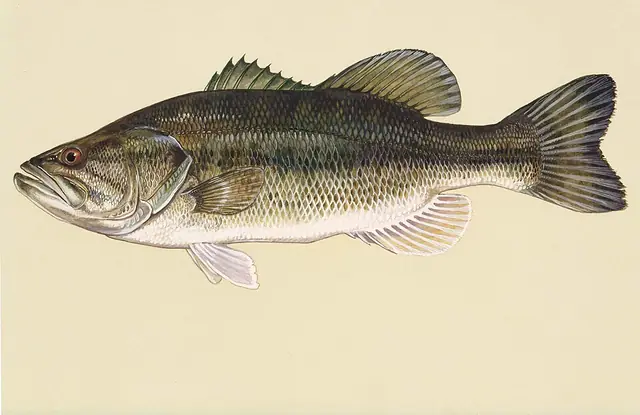

Key marks: Very large mouth: the upper jaw reaches far past the back of the eye. A broad, dark stripe along the side. The two dorsal fins are not well connected. Cheek scales are the same size as body scales.
Commonly confused with: Smallmouth and spotted bass: in both, the upper jaw reaches only to about the back of the eye, and cheek scales are much smaller than body scales.
Where in these waters: Reservoirs throughout the area. MDC reports largemouth plentiful in Table Rock; AGFC reports black bass at Beaver.
Smallmouth bass
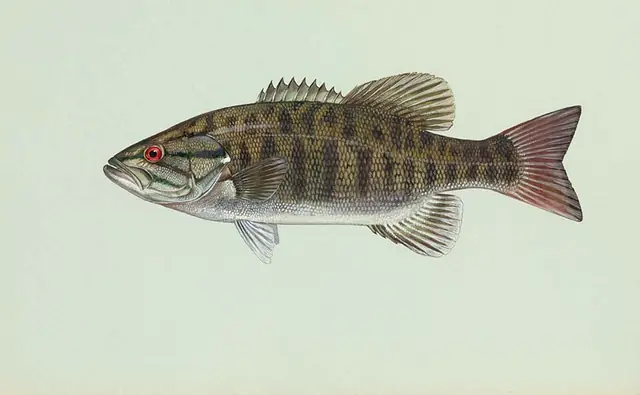

Key marks: Greenish-brown with faint dark mottling and vertical bars, and no dark side stripe. Upper jaw reaches only to about the back of the eye. Very small cheek scales; the two dorsal fins are connected.
Commonly confused with: Spotted and largemouth bass both have a dark horizontal stripe along the side. Smallmouth have vertical bars instead.
Where in these waters: Large Ozark reservoirs and cool, clear Ozark streams. MDC reports good smallmouth fishing in Table Rock's main lake.
Spotted bass (Kentucky bass)
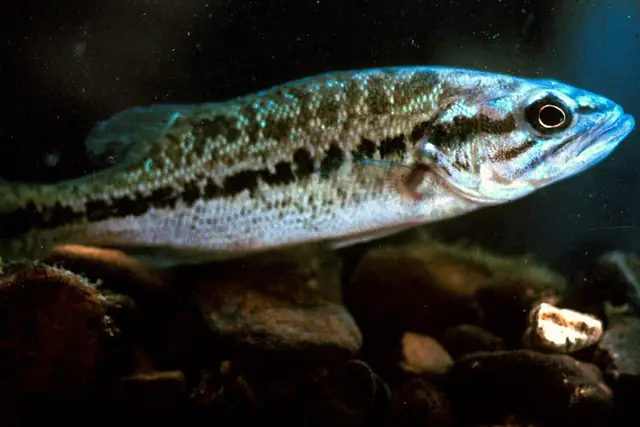

Key marks: Dark horizontal stripe with wavy edges, plus rows of dark spots on the lower sides that form streaks. Rough patch on the tongue, very small cheek scales, and connected dorsal fins. Juveniles have a black spot at the base of the tail.
Commonly confused with: Largemouth bass: the largemouth's upper jaw reaches far past the eye, and it lacks the rows of spots on the lower sides.
Where in these waters: Abundant in most large Ozark reservoirs. MDC reports spotted bass abundant in Table Rock.
Temperate bass
White bass
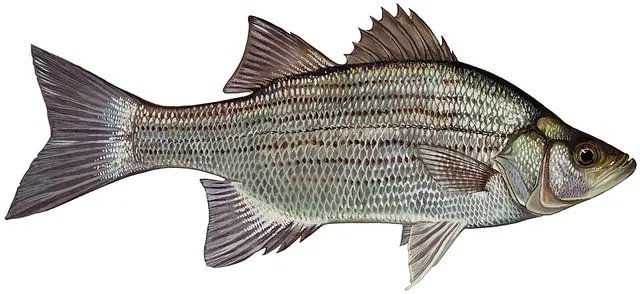

Key marks: Silvery with several dark horizontal streaks. Back strongly arched. A single heart-shaped tooth patch on the tongue. Seldom over 3 pounds.
Commonly confused with: Striped bass are slimmer, with body depth under ⅓ of length, unbroken stripes, and two parallel tongue tooth patches. Hybrids have broken stripes, 1 or 2 close tooth patches, and grow larger than white bass.
Where in these waters: Table Rock (spring runs up the river arms; trolling and spoons in summer), Beaver (AGFC reports white bass around Point 12 and Camp War Eagle), and Greers Ferry.
Striped bass (striper)
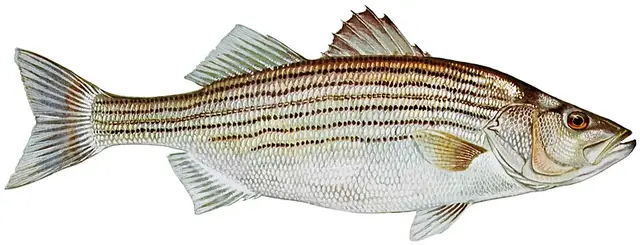

Key marks: Silvery and slender, with 3–5 unbroken dark stripes from behind the head to the tail. Two parallel tooth patches on the tongue. Commonly reaches 20 pounds.
Commonly confused with: Hybrid striped bass: hybrids are deeper-bodied, and their stripes are often broken or offset.
Where in these waters: Beaver and Norfork lakes. AGFC stocks stripers there because they can't reproduce in Arkansas lakes.
Hybrid striped bass (wiper)
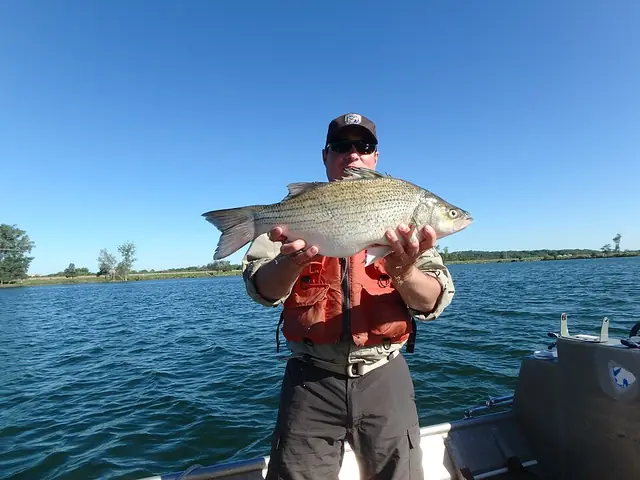

Key marks: White bass × striped bass cross. Silvery, with dark horizontal stripes that are often broken. Deep body, more than ⅓ of total length. Tongue has 1 tooth patch or 2 very close together. Often over 5 pounds.
Commonly confused with: White bass (smaller, single heart-shaped tooth patch) and striped bass (slimmer, unbroken stripes).
Where in these waters: Greers Ferry Lake (USACE lists hybrid striped bass there).
Crappie
White crappie
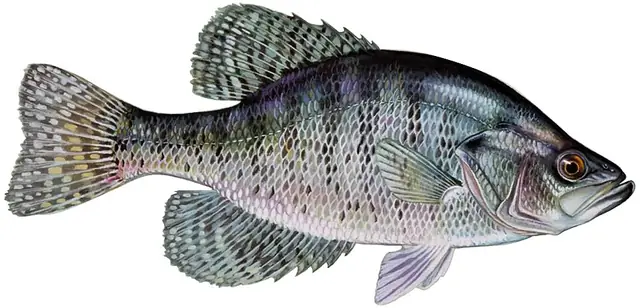

Key marks: Silvery and slab-sided, with 5–10 faint, regularly spaced vertical bars. Usually 6 dorsal spines.
Commonly confused with: Black crappie: irregular speckles and blotches instead of bars, and 7–8 dorsal spines.
Where in these waters: Table Rock (James, Kings and Long Creek arms) and Beaver. AGFC reports crappie at Beaver and Bull Shoals.
Black crappie
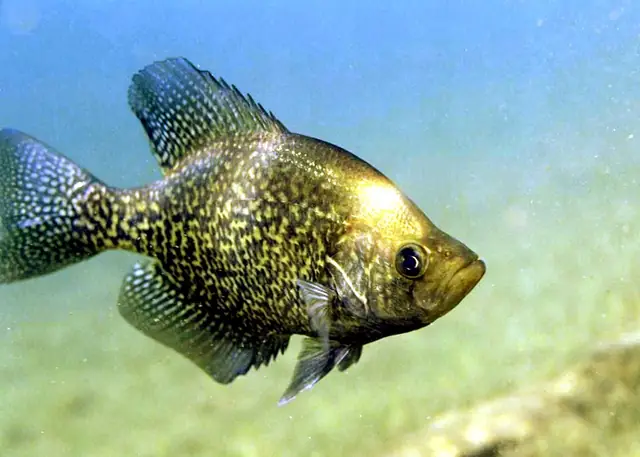

Key marks: Silvery with irregular speckles and blotches (not bars). 7–8 dorsal spines. Less tolerant of muddy water than white crappie.
Commonly confused with: White crappie (see above): count the dorsal spines or look for bars vs. speckles.
Where in these waters: Table Rock (MDC surveys found both crappie species) and other area reservoirs.
Walleye
Walleye
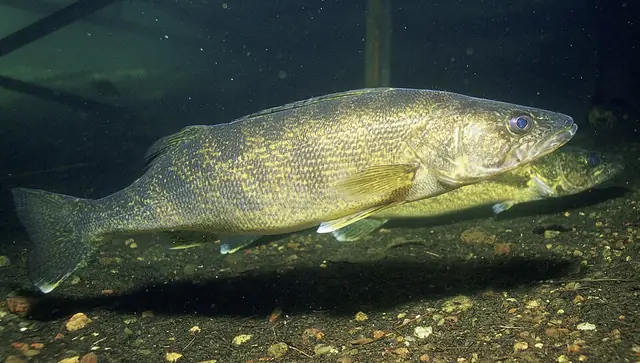

Key marks: Slender, with two separate dorsal fins and a large black blotch near the base of the last spines of the first one. Prominent teeth. Very reflective eyes. Yellowish to olive-brown with darker blotches; white belly.
Commonly confused with: Sauger and yellow perch, per MDC.
Where in these waters: Table Rock (around the dam and the upper river arms in spring), Greers Ferry, and Bull Shoals (in AGFC's report).
Sunfish
Bluegill
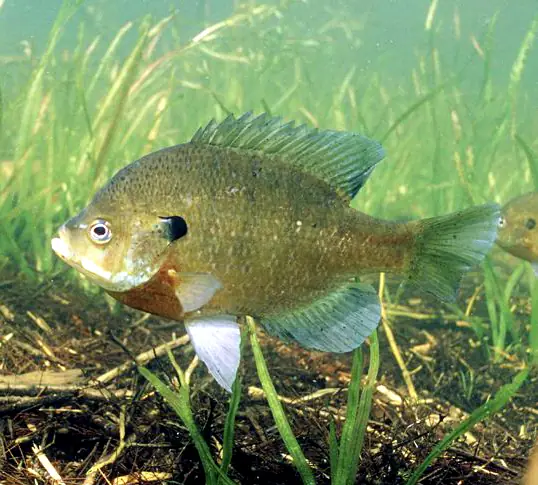

Key marks: Small mouth (upper jaw doesn't reach the eye). Long, pointed pectoral fins. Black ear flap. Often a black blotch at the rear of the soft dorsal fin. Blue chin and lower gill cover.
Commonly confused with: Green sunfish has a larger mouth (upper jaw to about mid-eye) and rounded pectoral fins.
Where in these waters: Table Rock (quality bluegill per MDC), Greers Ferry ("bream" per USACE), and nearly all area waters.
Redear sunfish (shellcracker)
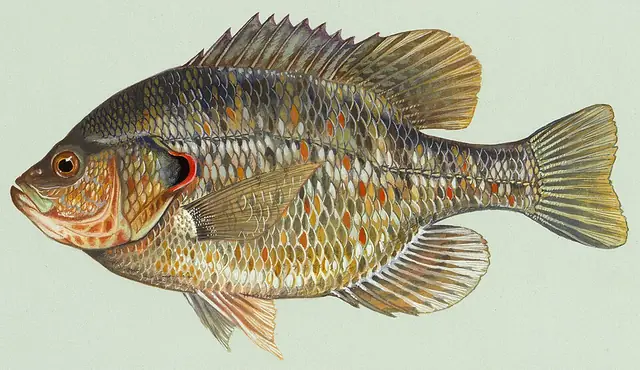

Key marks: Small mouth. Golden to light olive. The black ear flap has a whitish border and a prominent orange or red spot.
Commonly confused with: Bluegill and longear: look for the red or orange spot on the redear's ear flap.
Where in these waters: Table Rock, especially the James River and upper White River arms.
Longear sunfish
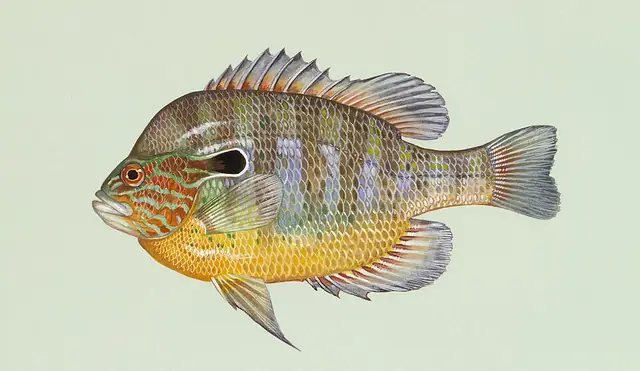

Key marks: Blue-green body speckled with yellow and emerald, and an orange or yellow belly. Sky-blue wavy lines on the head. Long black ear flap, often edged in white.
Commonly confused with: Bluegill and redear: neither has the long, white-edged ear flap or the blue wavy lines on the head.
Where in these waters: By far the most common sunfish in the southern half of Missouri (MDC). Found in reservoirs and clear Ozark streams.
Green sunfish
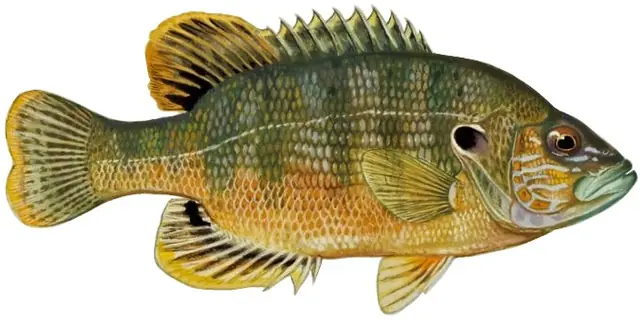

Key marks: Thick-bodied with a large mouth (upper jaw to about mid-eye). Blue-green with blue streaks on the head. Dark spot at the back of the dorsal fin. Rounded pectoral fins.
Commonly confused with: Bluegill: bluegill have a small mouth and long, pointed pectoral fins.
Where in these waters: Almost any pond, lake or stream (MDC).
Catfish
Channel catfish
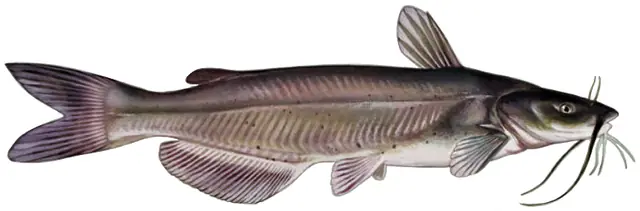

Key marks: Deeply forked tail. Scattered dark spots on the back and sides (often missing in the smallest and largest fish). Anal fin edge rounded outward, with 24–29 rays.
Commonly confused with: Blue catfish: blues never have dark spots, their anal fin edge is straight (like a comb) with 30–35 rays, and the head is more wedge-shaped.
Where in these waters: Table Rock (more common in the river arms per MDC), Greers Ferry (USACE), and most area waters.
Blue catfish
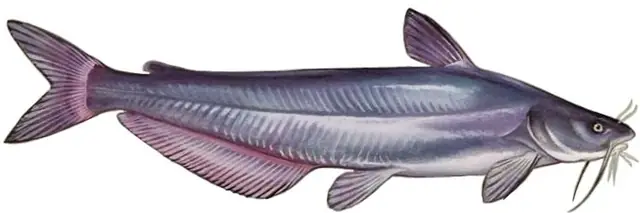

Key marks: Deeply forked tail, never spotted. Straight-edged anal fin with 30–35 rays. Steep, straight back profile gives a wedge-shaped head. Pale bluish silver.
Commonly confused with: Channel catfish (see above).
Where in these waters: MDC describes blues as big-river fish (Mississippi, Missouri, Osage). We haven't confirmed them in these specific lakes, so check local reports.
Flathead catfish
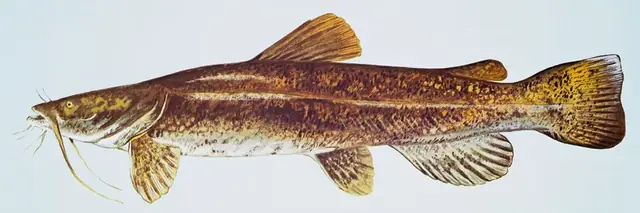

Key marks: Broad, flat head with small eyes on top. Lower jaw sticks out past the upper. Tail squared off, not forked, with a lighter upper tip. Mottled brown or black.
Commonly confused with: Channel and blue catfish both have deeply forked tails.
Where in these waters: Table Rock (more common in clearer main-lake areas near woody cover per MDC) and other area reservoirs.
Sponsor slot available for this page
🎣 Tailwater trout (below the dams)
Rainbow, brown, cutthroat and brook trout. Generation schedules and trout reports · Trout care tips · Lake species above ↑
Trout in these waters live in the cold tailwaters below the dams and in Lake Taneycomo; they need the cold water released from deep in the lakes.
Trout
Rainbow trout
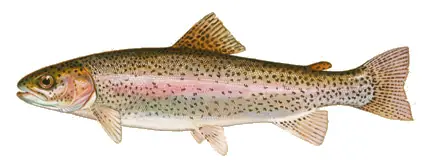

Key marks: Dark olive back thickly speckled with black spots, silvery belly, and a pink or reddish stripe along the side. Prominent dark spots on the tail, which is clearly forked. No orange or red spots on the sides.
Commonly confused with: Brown trout: browns have red or orange spots with lighter halos, and their tail usually has no spots. Rainbows have a spotted, forked tail and a pink side stripe.
Where in these waters: The most stocked trout. Found in the Bull Shoals, Norfork, Beaver and Greers Ferry (Little Red) tailwaters, and in Lake Taneycomo below Table Rock.
Brown trout
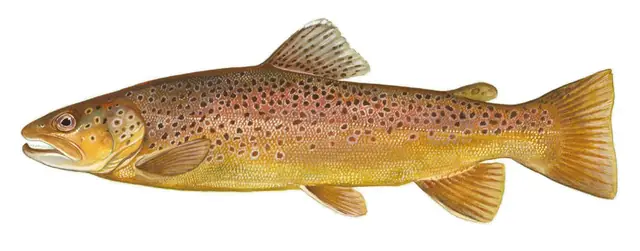

Key marks: Round black spots on the body and dorsal fin, plus small red or orange spots ringed with a lighter halo. The tail is usually not forked and usually has no spots.
Commonly confused with: Rainbow trout (see above). Brook trout have worm-like markings on the back and white-edged lower fins, which browns lack.
Where in these waters: Bull Shoals and Norfork tailwaters. AGFC says browns can reproduce in Arkansas, while rainbows need annual stocking.
Cutthroat trout
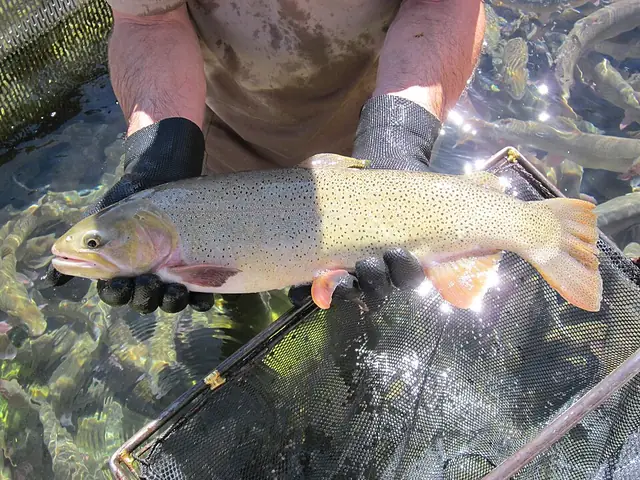

Key marks: A red-orange slash on each side of the lower jaw. Very few spots on the head, with more spots toward the tail. Body shape similar to a rainbow.
Commonly confused with: Rainbow trout: look under the jaw. The red-orange slash marks a cutthroat.
Where in these waters: Bull Shoals and Norfork tailwaters (less common than rainbows).
Brook trout
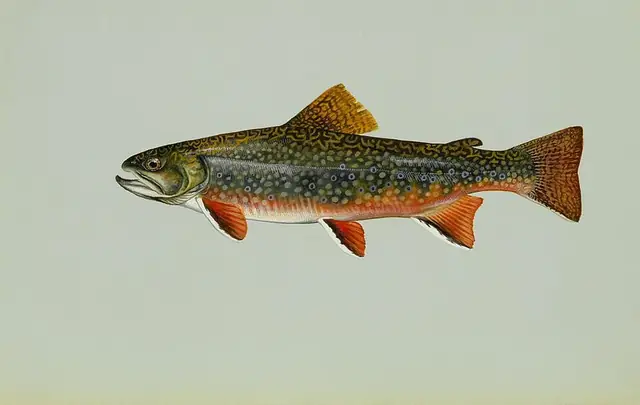

Key marks: Dark olive body with pale spots, worm-like markings (vermiculations) on the back, red spots often circled by blue halos, and red-orange lower fins with white leading edges.
Commonly confused with: Brown trout: browns lack the worm-like back markings and the white-and-black fin edges. Rainbow trout have uniform spots on the dorsal and tail fins; brookies don't.
Where in these waters: Bull Shoals and Norfork tailwaters (less common than rainbows).
Image credits
All images are U.S. government works in the public domain, downloaded from Wikimedia Commons. Most are U.S. Fish and Wildlife Service illustrations by Duane Raver.
- Rainbow trout: Duane Raver (Public domain), File:Truite arc-en-ciel.jpg
- Brown trout: U.S. Fish and Wildlife Service (Public domain), File:Brown trout FWS white background.jpg
- Cutthroat trout: USFWS Mountain Prairie (Public domain), File:Cutthroat Trout (51249445658).jpg
- Brook trout: Duane Raver, U.S. Fish and Wildlife Service (Public domain), File:Brook trout freshwater fish.jpg
- Largemouth bass: Raver Duane, U.S. Fish and Wildlife Service (Public domain), File:Largemouth bass fish art work micropterus salmoides.jpg
- Smallmouth bass: Raver Duane, U.S. Fish and Wildlife Service (Public domain), File:Micropterus dolomieu smallmouth bass fish.jpg
- Spotted bass (Kentucky bass): Dick Biggins, USFWS (Public domain), File:Micropterus punctulatus 1.jpg
- White bass: Raver Duane, U.S. Fish and Wildlife Service (Public domain), File:Morone chrysops white bass fish (white background).jpg
- Striped bass (striper): Raver Duane, U.S. Fish and Wildlife Service (Public domain), File:Striped bass morone saxatilis fish (white background).jpg
- Hybrid striped bass (wiper): USFWS Mountain Prairie (Public domain), File:Hybrid striped bass (51253333818).jpg
- White crappie: Raver Duane, U.S. Fish and Wildlife Service (Public domain), File:White crappie pomoxis annularis (white background).jpg
- Black crappie: Eric Engbretson, U.S. Fish and Wildlife Service (Public domain), File:Black crappie fish.jpg
- Walleye: Engbretson, Eric / U.S. Fish and Wildlife Service (Public domain), File:Sander vitreus.jpg
- Bluegill: Eric Engbretson, Division of Public Affairs (Public domain), File:Lepomis macrochirus photo.jpg
- Redear sunfish (shellcracker): Raver, Duane (Public domain), File:Redearsunfishnctc.jpg
- Longear sunfish: Duane Raver (Public domain), File:Lepomis megalotis2.jpg
- Green sunfish: Duane Raver (Public domain), File:Lepomis cyanellus Raver (white background).jpg
- Channel catfish: Duane Raver (Public domain), File:Ictalurus punctatus (white background).png
- Blue catfish: Duane Raver - U.S. Fish and Wildlife Service (Public domain), File:Blue catfish ictalurus furcatus fish (white background).jpg
- Flathead catfish: Duane Raver (Public domain), File:Flathead catfish.jpg